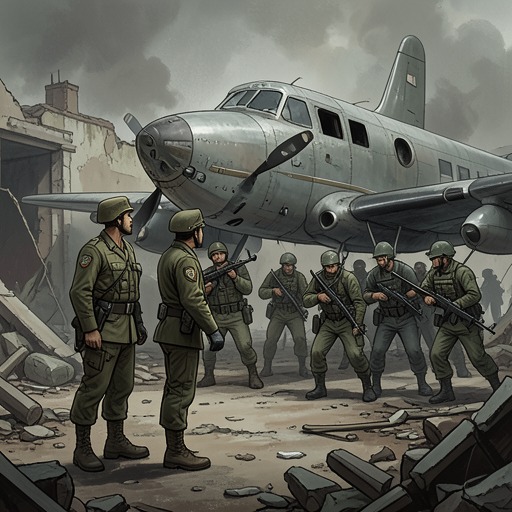
No man left behind
Black Hawk DownNo man left behind is the battlefield obligation that gives the rescue effort its moral force in the battle of Mogadishu. It binds soldiers to comrades who are trapped, wounded, or dead, but the book shows that fulfilling it is neither simple nor cost-free: rescue attempts expose more people to fire, while the pressure to protect one’s own can collide with the danger to civilians and with the limits of what a force can safely do.
The obligation under fire
The principle is tested from the mission’s opening moments, when strict rules of engagement require the Rangers to fire only at people pointing weapons at them. Armed Somalis are mixed among women and children, and crowds gather as barricades go up and gunfire draws people into the streets. In that setting, the effort to defend comrades cannot be separated from the risk of harming bystanders. The book presents the rule and the danger together: the soldiers are trying to survive an expanding battle, but the people around them are not all combatants.
At a house near the wreck of Cliff Wolcott’s helicopter, the obligation takes a more immediate form. Nearly three hours into the mission, wounded men fear they will be trapped there overnight, cut off from others pinned down near the crash. Commanders have judged a helicopter evacuation too dangerous, and the ground convoy expected at the site has been lost and badly mauled. Darkness is approaching, while the men lack the night-vision equipment they left behind for what they expected to be a short midday mission. The wounded need evacuation, but reaching them means sending others back into a city where the rescue force itself may be unable to get through.
Duty, fear, and the decision to go
The obligation to recover the wounded could not erase the danger of sending more men into the streets. When medic Tim Wilkinson returned across gunfire with bags of IV fluids, he told Scott Miller that one casualty, Carlos Rodriguez, was critical and needed to be evacuated immediately; the others could wait. Miller gave no answer, reflecting the grim reality that the men were in a position where even recognizing the most urgent need could not make a safe evacuation possible.
The same conflict arose when Sean Watson challenged an order to move out. Five wounded men needed transport, two of them on litters, and the body of Earl Fillmore also had to be carried. Watson argued that each litter would require four bearers, making the group an easy target as it crossed into a hail of bullets and grenades. He believed the men were safer holding their well-defended courtyard than attempting to reach another position. His resistance was not indifference to those who needed help; it was a direct dispute over whether a rescue attempt would preserve lives or add to the casualties.
For other Rangers, the obligation was inseparable from fear and the pressure of unit identity. Steve Anderson felt sick as the radio carried reports of the battle, and the sight of Dominick Pilla dead and Todd Blackburn gravely injured made him question what they were doing there. Brad Thomas, who had recently married, privately told Struecker that he could not go back out. He had decided the risk was more than he could accept, though refusing carried a steep cost for a Ranger. Struecker acknowledged that he, too, was scared, but told Thomas that the job still had to be done. Thomas walked away, then climbed aboard as the men prepared to leave. The episode frames courage not as fearlessness, but as action taken despite fear—and shows how the expectation of standing by fellow soldiers could draw a man back into danger even after he had resolved not to go.
The cost to those outside the unit
The same urgency that drew soldiers toward endangered comrades narrowed the space left for distinguishing combatants from civilians. The Rangers had been ordered to fire only when someone pointed a weapon at them, but armed Somalis moved among women and children, and people streamed into the streets as the fighting intensified. The rule was clear; applying it in a crowd where weapons and civilians were intermixed was not. The book places that difficulty inside the rescue effort, not outside it: the force trying to reach its own men was also moving through neighborhoods filled with people whose roles could not always be known in an instant.
One encounter makes the conflict painfully specific. As a convoy crossed an alley, a woman in a purple robe ran past carrying a baby. Eric Spalding shouted to the driver not to shoot because she had a child, but then the woman turned and raised a pistol with her free hand. Spalding shot her, then fired four more rounds as she fell. The vehicle was moving too fast for him to see whether the baby had been hit; he thought it probably had. The scene does not resolve the uncertainty that follows the shooting. The child’s presence had first prompted a warning, then remained the most unbearable unknown as the convoy pressed on.
By the return to base, the restraint imposed by the rules of engagement had given way for Dale Sizemore. Numb, angry, and intent on getting his friends back safely, he shot young boys, some armed and some not, and fired into crowds of women moving alongside riflemen. His loyalty to his fellow Rangers had become bound up with a desire to strike as many Somalis as possible. That change shows the danger in treating comradeship as an unlimited warrant: the impulse to protect the unit could sustain men through terror, but in the collapse of restraint it could also expose civilians to indiscriminate violence.
Abdikarim’s view from the streets widens the cost beyond the soldiers’ immediate field of vision. Near the market he saw dead men, women, and children, and an American soldier wounded in the leg and trying to hide. When a woman ran in front of him, the soldier fired in their direction; she was hit but escaped the street. A Little Bird helicopter then fired down an alley close enough for Abdikarim to press himself against a stone wall as bullets struck dust past him. He fled to a friend’s house and spent the night on the floor with others, unable to sleep. The rescue imperative therefore appears in two registers: as a promise among soldiers not to abandon one another, and as a force whose passage through a populated city brought danger to people with no place in that promise.
Recovery, captivity, and the limits of rescue
More than nine hours into the night, with the shooting largely quiet, Mike Steele understood that the approaching rescue force could itself become the greatest danger to the men pinned down near Cliff Wolcott’s wreck. Two groups moving through the dark, confused city were firing heavily as they closed on one another. The prospect of rescue therefore carried a terrible irony: the men coming to recover their comrades might mistake them for the enemy. The order to prepare to leave came shortly before 2 a.m., with a warning to keep low because the moment of linkup was especially dangerous.
The same obligation to recover the missing confronted the soldiers watching the image of a dead American being dragged through the streets. Some pilots wanted to attack the crowd, land, and retrieve the body. Their commanders refused: with so many people gathered around it, an assault would become a massacre. The refusal did not mean the dead man mattered less. It showed that the commitment to bring comrades home operated under limits, including the lives of people outside the unit.
Others accepted extraordinary personal risk in the search. John Macejunas had already gone into the fighting several times, and when the rescue convoy could not reach Michael Durant’s crash site, he led a small squad there on foot, looking for his friends. Now dressed as a civilian journalist, he prepared to go back into the city to find his fellow soldiers, alive or dead. His repeated returns make the principle more than a promise spoken at a safe distance: it becomes a task undertaken again after earlier searches and fighting have failed.
For the men who had made it back to the hangar, the commitment did not end with the rescue column’s return. The D-boys were already cleaning weapons, checking equipment, and restocking ammunition, ready to go out again. Michael Durant, meanwhile, was still captive and wounded. On the night of October 4, American helicopters flew overhead broadcasting that they had not left him and remained with him. When he was released, the men at the hangar turned out to salute as he was carried past on a litter, an IV in his arm and his unit’s red beret in his hand. The welcome held relief and grief together: he was the only member of his four-man crew and the two Commando defenders to return.
The scale of the losses gives the promise its final weight. Eighteen Americans were dead and 73 wounded; more than 500 Somalis were dead and at least a thousand injured. The battle had been fought to capture two men who remained little known after it. In that disparity between the rescue’s intimate loyalty and the devastation across the city, the book leaves the obligation neither disproved nor uncomplicated: comrades were not to be abandoned, but reaching them exacted a price borne far beyond the unit.